Perfume OEM: A Realistic Way to Start with Minimum Cost
Most people preparing a perfume brand first look for “the cheapest way to start,” and begin by comparing manufacturers offering the lowest unit price. But what actually determines an early brand’s burden is often not the unit price.
The benchmark for minimum cost is inventory, not unit price
Shaving a little off the price of a single bottle matters far less than unsold inventory piling up. If you produce thousands of units to meet a minimum order and the market response differs from expectations, that inventory becomes locked-up capital.
So “starting with minimum cost” is less about cutting the unit price and more about not betting everything at once — starting within a range you can validate. From this angle, where you should cut costs becomes clear.
The structure of early perfume costs
Perfume production costs arise mainly across five items.
| Item | Detail | Early burden |
|---|---|---|
| Fragrance | Scent development & sourcing | Higher for new compositions |
| Containers & components | Bottle, pump, cap, carton | Separate MOQ, surprisingly large |
| Design | Label & packaging | Varies by spec |
| Licensing | Filing & registration | Essential fixed cost |
| Manufacturing | Blending, filling, packing | Varies by quantity |
Many focus on the fragrance unit price, but in practice costs build up in containers and components. Bottles and pumps each have their own minimum order quantities, so even when you plan a small run, you may have to secure far more components than you need.
Four levers to realistically reduce cost
The key is not to cut blindly, but to defer costs that aren’t essential at the start.
1. Use an existing fragrance base
Developing a brand-new scent from scratch increases both cost and time. Using a manufacturer’s existing fragrance base, or modifying it partially, can greatly reduce the initial development burden.
2. Stock containers instead of a custom mold
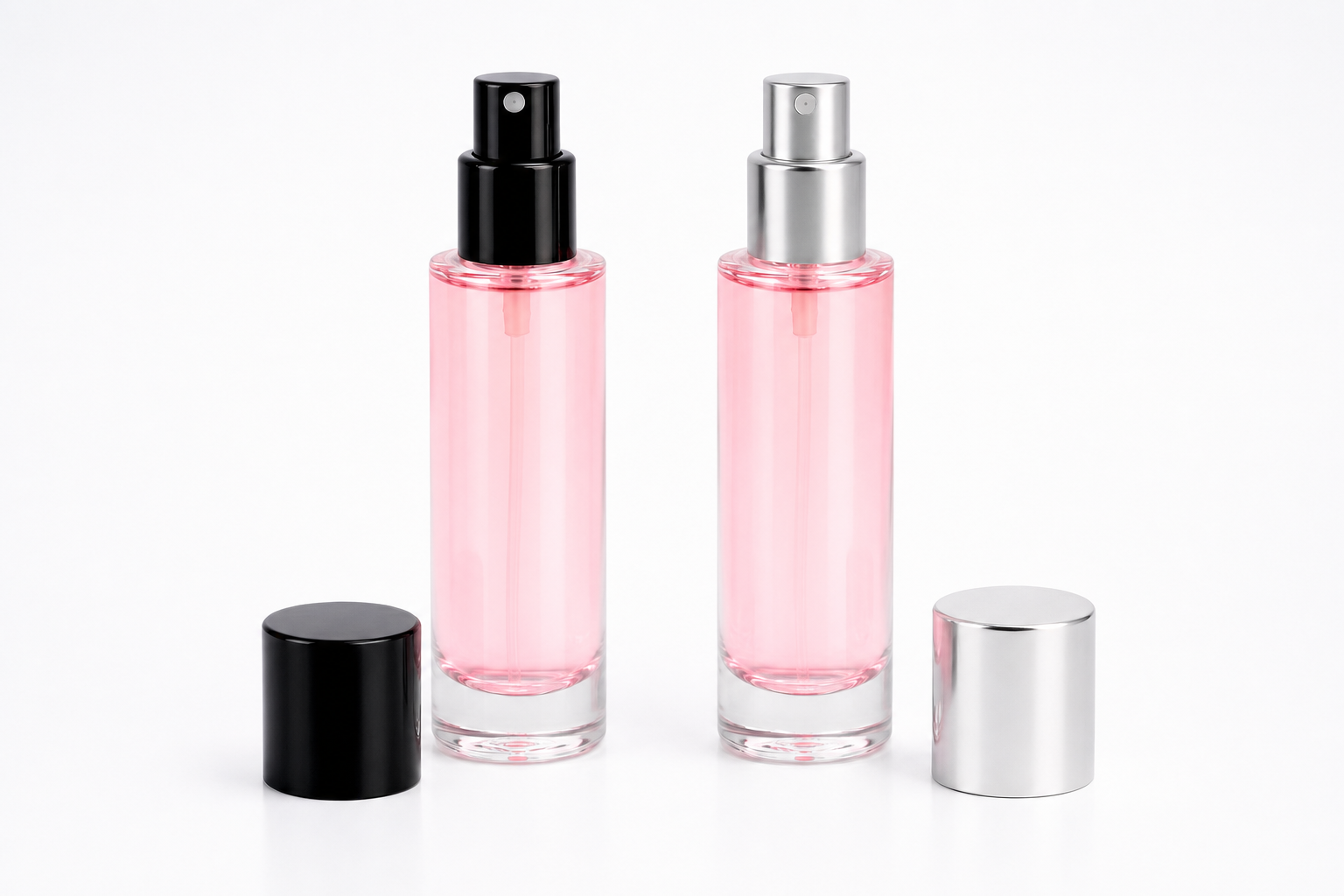
A custom mold is expensive. What matters here is which containers the manufacturer already holds. Containers carry large minimum order quantities that burden early brands, but if a manufacturer keeps a variety of container designs in-house, you can start with stock containers without placing a large separate order. Reviewing a custom container after confirming market response is the safer order.
3. Minimum packaging spec
Cartons, finishing (foil, embossing), and inserts add cost each time you add them. At the start, a label and a basic carton are often enough.
4. Start with one scent, then expand
Launching several scents at once means meeting a minimum for each, multiplying the burden. Starting with one validated scent and expanding the line after confirming demand is the most effective way to reduce inventory risk.

The manufacturer you choose determines the cost structure
To actually apply these levers, the manufacturer’s capabilities must back them up. Whether they can develop and modify scents directly, source fragrance in-house, and handle containers, components, and licensing in one place changes your initial cost structure.
Splitting the work across several vendors stacks up communication costs and margins at each step. You can also read about how to choose a manufacturer in How to tell a direct manufacturer from a broker in perfume OEM.

RAINT’s approach
RAINT is a direct manufacturer that runs everything from scent development to production in one place. We source all fragrance in-house, and qualified perfumers and aromatherapists develop the scents directly. This makes it possible to lower the initial development burden by using or modifying an existing fragrance base.
We also keep a variety of perfume container designs in-house, so you can start with stock containers without placing a large separate container order — a meaningful way to reduce the early burden on the container side. With 13+ years of experience and a 2,200-pyeong in-house facility, we produce under ISO 9001 and ISO 22716 certification, and we handle licensing and filing in-house to reduce the client’s burden. The minimum order is 2,000 units per scent and 5,000 units in total; details are available at raint.kr/inquiry.
Conclusion
The key to starting with minimum cost is not cutting the unit price but designing to reduce inventory risk. Use the four levers — existing fragrance, stock containers, minimum packaging spec, and one-scent focus — and choose a one-stop manufacturer that can realize them, and you can keep initial costs under reasonable control.
Frequently asked questions
Q. Can perfume be made in small quantities?
There is a minimum order quantity for production stability. However, focusing on one scent rather than splitting across several can reduce the burden, and we’ll advise on the approach that fits your situation during consultation.
Q. Which item costs the most?
New compositions and custom containers/components. We recommend starting with an existing fragrance and stock containers.
Q. Can I know the unit price in advance?
It varies by scent, volume, container, and quantity, so it’s hard to quote uniformly. Based on your plan, we’ll break it down item by item during consultation.
From manufacturing to brand management, talk to RAINT for a one-stop partnership.
Get in touch